

Collaborative post
Somewhere between the nursery waiting list and the second viewing that falls through, most parents renting in London reach the same conclusion: nobody warned them quite how much of the monthly budget this would eat. Rent is the headline cost, but it is rarely the whole story once childcare, deposits and moving fees are added in.
If you are weighing up a move with young children in tow, or already renting and wondering whether the sums still add up, here is what the 2026 numbers actually show, and what has changed for families this year. None of it is complicated once it is laid out properly, but very little of it gets covered in the average property listing.
Key Takeaways
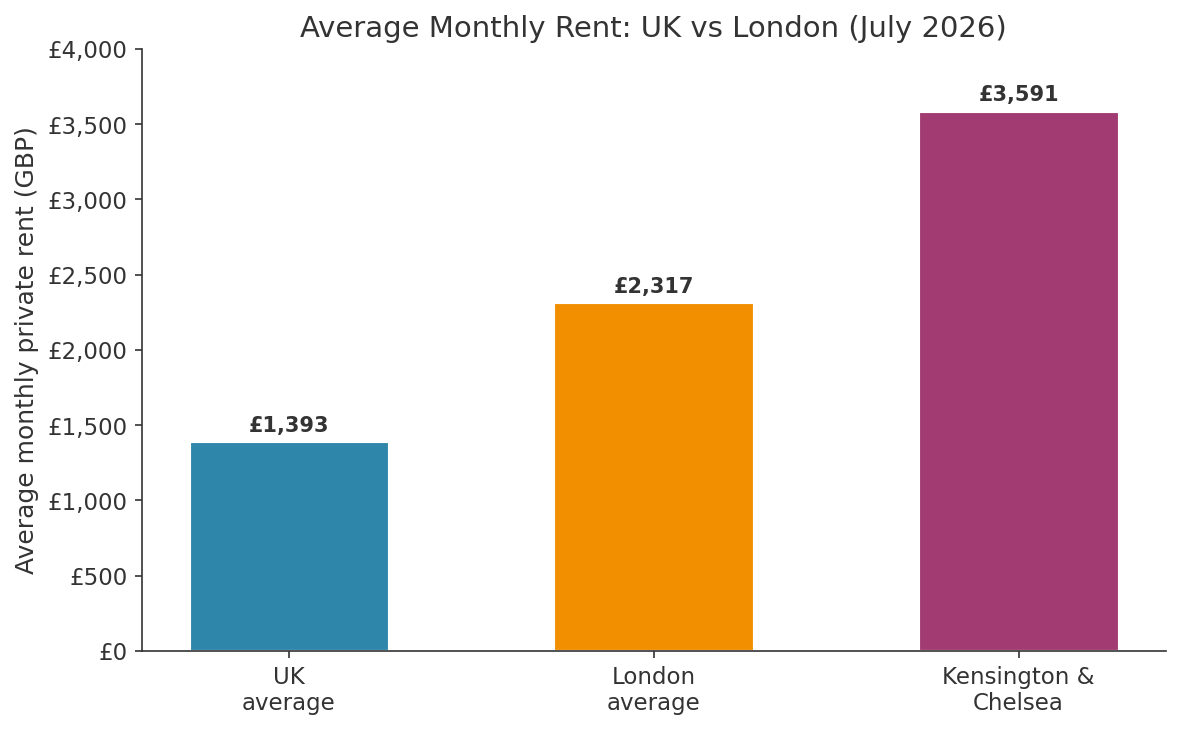
- Average private rent in London reached £2,317 in July 2026, more than 65% above the UK average.
- A typical two to three bedroom home away from central London runs to roughly £2,200 to £3,500 a month.
- Childcare remains the other major line item, though funded hours have cut costs sharply for eligible households.
- New tenancy rules ended Section 21 ‘no fault’ evictions from 1 May 2026, giving renters more long-term security.
- Outer boroughs such as Bromley continue to draw families priced out of the inner city, without losing green space or decent schools.
What It Actually Costs to Rent With Children in London
The headline figure from the Office for National Statistics puts average private rent across London at £2,317 a month in July 2026, up 3% on the year. That compares with a UK-wide average of £1,393, so the capital’s premium remains substantial even as annual rent inflation has slowed from its 2024 peak. Inner London carries most of that premium; Zones 3 to 6 tend to sit meaningfully below the citywide average once you move away from the most sought-after postcodes.
| Household item | Typical monthly cost (family of four) |
|---|---|
| Rent, two to three bedrooms | £2,200 to £3,500 |
| Council tax (Band D) | £150 to £200 |
| Energy (gas and electricity) | £150 to £250 |
| Water and wastewater | £50 to £55 |
| Transport (two adults, Zones 1 to 2) | Around £312 |
| Fast Fact: Households with at least one dependent child spend around £58 a month more on rent than childless renters, according to English Housing Survey data. |
None of this accounts for the deposit, typically capped at five weeks’ rent, or the moving costs that tend to land all at once: removal vans, first and last month upfront, and often a holding deposit before that. Once the numbers work for your household, the next sensible step is finding a letting agent who understands what tenants with children actually need, rather than treating every enquiry the same way. Wextons estate agents, who have specialised in London lettings for close to two decades, are worth speaking to early in that process, well before you commit to a shortlist of properties.
The Cost Most Family Budgets Overlook: Childcare
Rent gets most of the attention, but childcare is often the second-largest item on a household budget, and one that catches new parents off guard. The good news is that prices have fallen meaningfully over the past two years as funded hours expanded.
Coram’s 2026 Childcare Survey found that eligible working households now pay around £149 a week for a full-time nursery place for a child under two, a 39% drop since 2025 after funded hours rose from 15 to 30 per week. Families who fall outside the eligibility criteria pay considerably more, averaging £189 for a part-time place alone.
For plenty of households, the nursery invoice still rivals the mortgage or rent, even after this year’s funding changes.
Inner London settings tend to sit £60 to £100 a week above outer London equivalents, which is worth factoring in alongside rent when comparing boroughs rather than treating the two costs in isolation.
What Changed for Renting Households in 2026
The biggest shift in the rental market this year has little to do with price. New legislation came into force on 1 May 2026, ending so-called no-fault evictions across England for good.
| ▶ Video: “Renting in London in 2026? This Could Save You £1000s (New Laws May 1st)This explainer covers the practical impact of the new tenancy rules for renters, including the bidding ban and the shift to rolling tenancies. |
| Worth Knowing: Landlords can no longer end a tenancy simply because a fixed term has expired. They must now rely on specific legal grounds, such as rent arrears, antisocial behaviour or a genuine intention to sell. |
For details on what the reform means in practice, Shelter’s guide to the changes sets out tenant protections in plain terms, including the move to rolling periodic tenancies that no longer carry a fixed end date. For parents, this matters more than it might first appear: a child settled into a school or nursery place no longer faces the same risk of an unexplained move at the end of a twelve-month contract. Landlords have not lost the ability to regain their property when they genuinely need to, but the days of ending a tenancy with no explanation at all are over.
Choosing an Area That Actually Works for Family Life
Not every London postcode suits a family’s budget or its daily routine, and the areas that tend to work well share a few common features.
- Outer boroughs generally offer more room for the same monthly budget than Zones 1 and 2
- Proximity to a well-regarded primary school catchment matters more than headline square footage
- Genuine outdoor space within walking distance takes real pressure off weekend planning
- A direct rail or tube line into central London keeps the daily commute realistic for working parents
Bromley illustrates the trade-off well. Kelsey Park’s 17 hectares of estate parkland and lake give families a proper stretch of outdoor space, while Down House, Charles Darwin’s former home, adds an easy day out that happens to be educational too. Before planning a visit, the National Trust’s page for Down House is worth checking for opening times and family activities. Other outer boroughs worth researching for similar reasons include Sutton, Bexley and parts of Croydon, each offering a broadly similar mix of larger homes, decent schools and a workable commute into the centre.
Renting further out does mean accepting a longer commute in exchange for space, and that trade-off is worth running through honestly before signing anything. A ten-minute difference on paper can turn into a genuinely difficult evening routine once nursery pickup, dinner and bedtime all have to happen in the same tight window.
Practical Habits Worth Adopting
A handful of practical steps make the whole process considerably less stressful once children are part of the equation. None of these take long to check, but skipping them is usually what turns a straightforward move into a stressful one.
- Confirm school catchment boundaries before falling for a property, not after
- Check the deposit protection scheme details in writing before handing over any money
- Budget the full moving cost, not just the first month’s rent, including removals and any agency fees
- Read the tenancy agreement’s pet and redecoration clauses carefully if either matters to your household
- Keep a dated, photographed record of the property’s condition at move-in
Frequently Asked Questions
How much does renting with children cost in London right now?
A two or three bedroom property away from the centre typically runs from around £2,200 to £3,500 a month, depending heavily on borough and property condition, on top of council tax, energy and transport costs.
What changed under the new tenancy rules in 2026?
Section 21 notices ended on 1 May 2026, fixed-term tenancies became rolling periodic agreements, and landlords must now show a specific legal ground before seeking possession of a property.
What does nursery cost for a typical household?
Eligible working families pay an average of £149 a week nationally once the 30 funded hours are applied to a full-time under-two place, though settings in the inner city commonly charge £60 to £100 more than those further out for identical hours.
Is renting further from central London genuinely cheaper for a family?
Usually yes. Outer boroughs and the wider commuter belt tend to offer noticeably more space for the same budget, though this needs weighing against a longer or pricier daily commute.
What should come first when choosing where to settle?
School catchment areas, real access to green space and a commute that survives the school run tend to matter far more over time than an extra bedroom or a slightly shorter walk to the station.
Renting a home for a young family in London was never going to be straightforward, and this year’s figures do not pretend otherwise. What has genuinely improved is stability: the end of no-fault evictions and a clearer picture of the true monthly cost make it easier to plan several years ahead rather than one tenancy at a time. For households weighing up the move, that security is worth almost as much as the figure on the listing itself, and it is a good reminder that the cheapest rent on paper is not always the one that serves a family best over the following two or three years.
References
Office for National Statistics, Private rent and house prices, UK: August 2026 — https://www.ons.gov.uk/economy/inflationandpriceindices/bulletins/privaterentandhousepricesuk/latest
Coram Family and Childcare, Childcare Survey 2026 — https://www.coramfamilyandchildcare.org.uk/research/childcare-survey-2026/
Shelter England, Renters’ Rights Act changes for private renters — https://england.shelter.org.uk/housing_advice/private_renting/renters_rights_act_changes_for_private_renters
GOV.UK, When will the Renters’ Rights Act come into force — https://www.gov.uk/government/news/when-will-the-renters-right-act-come-into-force
National Trust, Down House — https://www.nationaltrust.org.uk/visit/kent/down-house
Fact Check: All statistics and data points in this article were verified against original sources as of 10 September 2026. Sources are listed in the References section above.