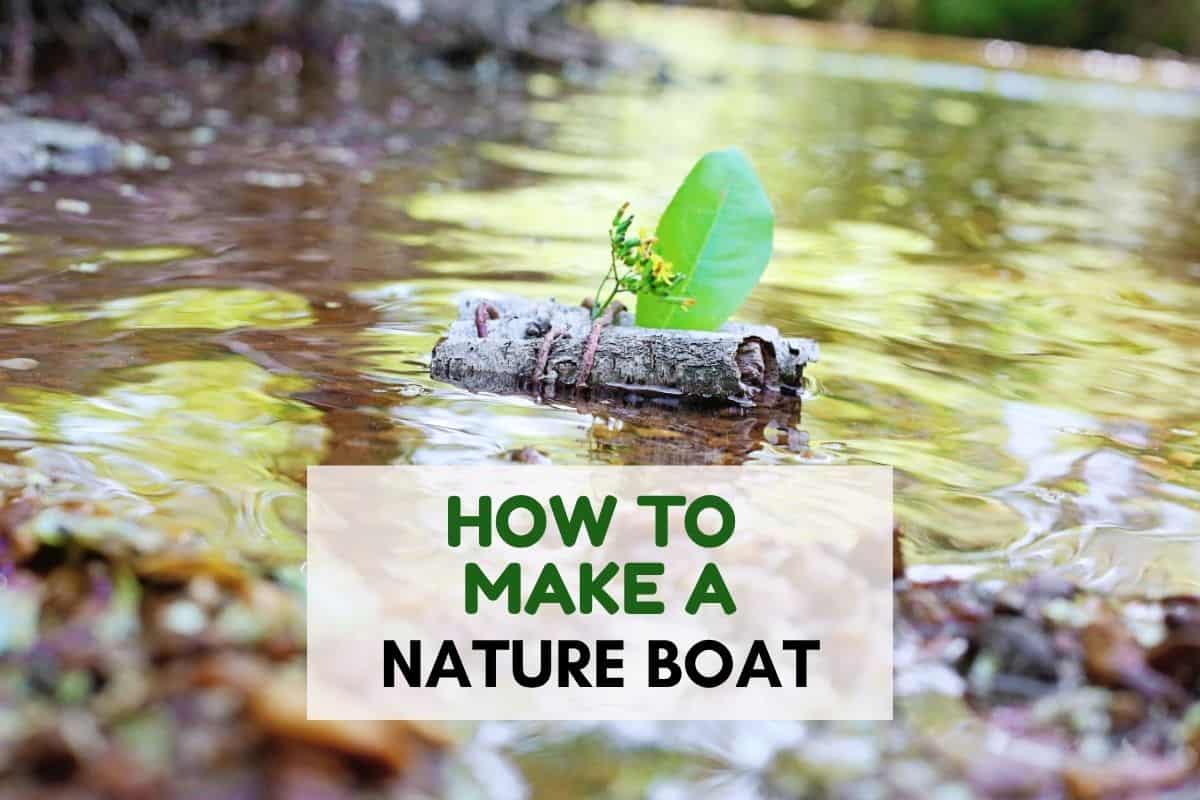
Find out how to make a nature boat which is a great activity to do outdoors with kids. This is a fun outdoor for kid’s activity that encourages nature exploration and simple STEM learning as well as a bit of creativity too. Using free natural materials such as sticks, bark and leaves, children can build their own floating boats and test them on ponds, streams or water trays. Find more outdoor activities for kids here.
This article provides you with step by step instructions for crafting a nature boat. It could be a bark boat or a stick boat. It will also provide ideas for things to do with your boats once you have made them, including STEM activities. Finally I will share the benefits of these activities and the learning your will complete.
My children love making tiny nature boats and then floating them in a stream. Even a puddle on a rainy day. There is the craft element of making the boats followed my a hands on STEM activity where they race boats and test ideas for how to make the fastest boat. You can find more STEM activities for your boats later in this post.
Supplies needed to make a nature boat
You don’t need a lot of supplies to make a nature boat and most of them are natural materials that you can find in your yard, in the forest or on a family hike. You might like to take some string with you in case you can’t find any flexible stems.
- Bark pieces
- Twigs and small sticks
- Leaves
- Grass, vines, or flexible stems (or use twine if you can’t find anything suitable.
- Small flowers, pebbles, or seed pods (optional extras)
- Access to a shallow creek, stream, or tub of water


How to make a nature boat
Learning how to make a nature boat is a fun outdoor activity that combines creativity, nature exploration and simple STEM learning. Using sticks, bark, leaves and other natural materials, children can build their own floating boats and test them on ponds, streams or water trays.
Materials
- Bark pieces
- Twigs and small sticks
- Leaves
- Grass, vines, or flexible stems
- Small flowers, pebbles, or seed pods (optional extras)
Tools
- Optional - Twine and scissors
Instructions
- Start by gathering your supplies - Head outside and let kids collect natural treasures like bark, sticks, leaves, and grass. Look for lightweight pieces.
- Build the base of your boat - Use a flat piece of bark as the main raft, or line up several small sticks side by side to form a base.
- Secure the structure - Wrap grass, vines, or flexible stems around the sticks to hold everything together. Twist and tuck to secure. If this proves too difficult, you could use twine or string.
- Add a sail - Attach a leaf to a small twig and stick it into the base to create a sail.

- Decorate your boat - Add flowers or extra leaves to give your boat personality.
- Test your boat - Place the boats gently into a creek or water. Watch how they float, drift, spin, or sail away.

Why make nature boats?
There are lots of benefits of making nature boats with kids. For example, it includes creativity, problem solving, STEM and nature play.
Here are the benefits:
Hands-on creativity – Kids become little engineers using only what nature provides to create cute little boats. There are loads of possibilities for natural materials to use and each boat will look a little different.
Problem-solving skills – Testing and redesigning nature boats builds critical thinking. Perhaps the first one doesn’t float, can they work out why? Perhaps their boat loses a race, how can they make the next one faster?
Fine motor development – Fine motor skills are so important. There are lots of ways that kids practice fine motor skills. For example, tying things together, placing and picking up small items, and building generally strengthens small muscles of the hands.

Connection to nature – This activity encourages exploration and appreciation of the great outdoors. I strongly believe in getting young children out in nature and noticing the natural material is so important. Children who spend loads of time in nature as children will grow up to enjoy nature as adults.
STEM learning – This activity introduces basic concepts like buoyancy, balance, and structure.

Imaginative play – Some children will love making up stories about the little boats they make. Perhaps it will be about whose boat they are, where they are going and the adventures they are having.

Nature boat STEM activities
Once your child has built a nature boat, it’s time for kids to become a scientist and engineer. These challenges encourage children to test, improve and redesign their boats. Making and testing a nature boat helps children explore how things float, solve problems and think creatively.
Challenge 1: Which Boat Floats Best?
Create several boats using different natural materials such as bark, sticks, leaves or reeds.
Ask children to predict:
- Which boat will float for the longest time?
- Which boat will be the most stable?
- Which boat will sink first?
Test each boat and compare the results. This challenge includes the following STEM Learning – Buoyancy, prediction, observation and recording results.
Challenge 2: Pebble Cargo Test
How much weight can your nature boat carry before it sinks?
Place the boat in water and slowly add small pebbles one at a time. Then count how many pebbles the boat can hold before it starts to take on water or sink. You might like to record the results and compare different boat designs.
This challenge includes the following STEM Learning – Weight, capacity, counting and data collection.
Challenge 3: Build the Fastest Boat
Place your boat in a stream or gently blow on the sail to create wind power. Try changing the size or shape of the sail and test again. Racing boat is usually a very popular activity.
You can measure which boat travels the furthest? or fastest? Which sail design works the best?
This challenge uses the following STEM Learning – Forces, movement, fair testing and measurement.

Challenge 4: Improve Your Design
Engineers rarely get things right on the first attempt.
After testing the first boat, ask:
- What worked well?
- What could be improved?
- How could you make the boat stronger?
- How could you help it carry more weight?
Then children can make changes and test again.
The following STEM Learning is included in this challenge – Engineering design and problem-solving.
Challenge 5: Wind-Powered Boats
Create sails using leaves of different shapes and sizes. Encourage your children to predict which sail will catch the most wind.
You can test the boats by using the wind or if it isn’t windy then blowing gently or using a fan works too.
Don’t forget to measure how far each boat travels and discuss why they think that sail design works best.
STEM Learning in this challenge – Forces, air movement and investigation skills.
Challenge 6: The Longest Floating Boat
Who can build a boat that will float for the longest? This doesn’t necessarily need to be the fastest!
To test this, start a timer and see how long each boat remains afloat. Encourage children to improve their design to increase the floating time. You might like to record the results in a simple table.
STEM Learning in this challenge – Timing, observation and recording data.
Challenge 7: Nature Boat Race
If you have several boats, organise a race. Children can make predictions before the race and explain why they think a particular boat will win. Discuss what features helped the winning boat travel quickly.
STEM Learning included – Prediction, analysis and critical thinking.
Questions to Ask Children
Encourage deeper thinking with questions such as:
- Why do some materials float while others sink?
- What shape makes the strongest boat?
- Why did one boat carry more pebbles than another?
- How does a sail help a boat move?
- What would you change if you built another boat?
- Which natural material worked best and why?
These questions help children think like scientists and engineers while having fun outdoors.

Safety tips
Make sure that you supervise children well during these challenges and when building their nature boats. It’s important to make sure they don’t put natural items in their mouths, choose nature that you know to be poisonous or irritant and of course ensure they stay safe around water.

More nature activities for kids
Find loads of nature activities for kids here.
Find more things to do with sticks here.
If you enjoyed this, you’ll love my guide to forest school activities to do at home.