
Collaborative post
For parents whose children are at the moment very engrossed in playing Minecraft, you will be well aware of how difficult it can be to coax them off the computer and into some physical activity. It might be nice to let your children play video games since it is a great way to stimulate their imagination, but it’s even better when they actually create something tangible. At The Ladybird’s Adventures, we truly believe that childhood is short and no one remembers their best ever day of watching TV, but they certainly remember the afternoon they spent covered in glue or building a giant fortress out of blocks.
The good news is that we don’t have to fight the gaming obsession; we can actually use it as a bridge to some fantastic offline activities. Pixel art—the art of building images out of small, square units—is the perfect “stepping stone” from the digital world to the kitchen table. Whether you are using Hama beads, Lego bricks, or just a simple pad of graph paper, these activities are packed with “sneaky maths” and STEM learning that your children won’t even realise they are doing.
Why hands-on crafting beats the screen
When children are clicking away on a mouse or tapping a screen, they are using a very limited range of movements. In contrast, physical pixel art is a masterclass in fine motor development. Every time your child picks up a Hama bead or clicks a Lego brick into place, they are refining their pincer grip—the coordination between the thumb and index finger. This might seem like a small thing, but it is actually a vital precursor to good handwriting and even the ability to use cutlery or tie shoelaces.
Apart from the physical advantages, these activities instil a sense of discipline and patience not common in video games. There is no “undo” function in the real world, meaning that when beads fall or Lego tumble, you get to learn about perseverance and problem-solving. “Learning through playing” is precisely what we are passionate about, no pressure, just lots of curiosity and hands-on fun.
Magic of spatial reasoning
One of the most important skills your child will develop through pixel art is spatial reasoning. This is basically the ability to understand how objects move and fit together in a 3D world. Research at the University of Surrey has found that children with good spatial skills are better at understanding complex maths concepts such as geometry and measurements.
When the child sees a Creeper design from Minecraft and reproduces it on the grid, the child is using a technique called “spatial scaling”, where they mentally transform the small picture into a large object. In essence, the child is already manipulating basic X and Y coordinates. Each square on their pegboard or paper represents a specific location, helping them understand how points relate to each other in space.
Solving the “square circle” problem
If you’ve ever tried to draw a circle on a piece of graph paper, you’ll know it’s a bit of a head-scratcher. Because pixels are square, a “perfect” curve is technically impossible. This is a wonderful moment for a bit of sneaky geometry! You can talk to your kids about “rasterisation”—the way computers approximate curves using blocks.
To build a round coaster or a circular base for a tower, children need to understand the radius, which is the distance from the centre to the edge. A brilliant tool for this is the Minecraft circle generator, which shows them exactly where to place their “pixels” to create the illusion of a curve. By following a generated template, they’ll notice patterns—like “three blocks, then one, then one, then three”—which introduces them to the concept of symmetry and algorithms without them even knowing it. It’s a fantastic way to turn a tricky maths problem into a satisfying crafting project.
Hama beads: precision and planning
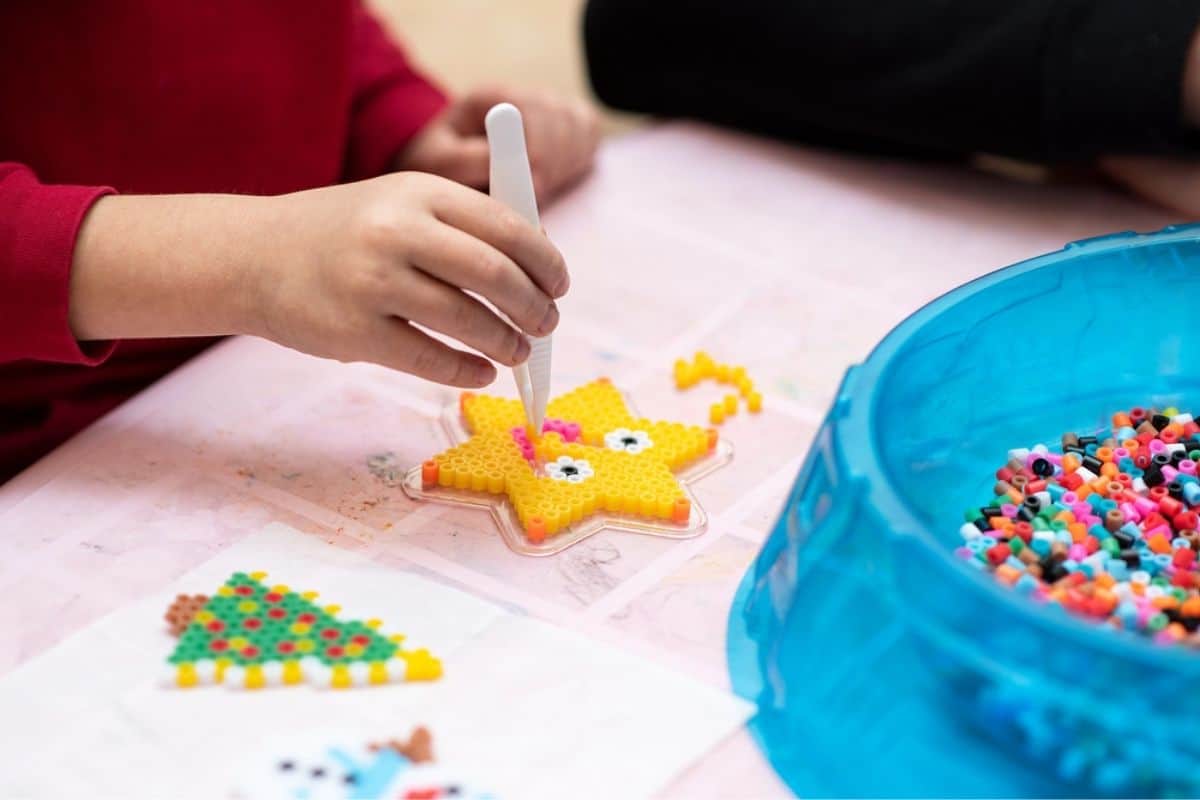
Hama beads (also known as Perler or melty beads) are a favourite in our house because they are so versatile. They are small, heat-activated plastic beads that you arrange on a pegboard before an adult fuses them together with an iron.
For parents, a few tips can make this a much smoother experience. We recommend sorting your beads by colour into compartment boxes or even silicon muffin tins before you start. It prevents that frantic search for “one last blue bead” and allows the children to focus on their design. Starting with the outline of the character is usually the easiest way to ensure everything fits on the board. Once the design is finished, remember to use a medium heat and a circular motion with the iron to get an even melt. For more ideas on how we use these little beads in different ways, you might enjoy our post on Christmas tree play-dough, where we used Hama beads for some festive fine motor decorating.
Lego mosaics and structural logic
Besides using Lego to build tall structures, it can be used as a great medium for pixel art in 2D. Constructing a Lego mosaic involves counting “pips” or studs on individual bricks. It is all about developing numeracy and understanding one-to-one correspondence, meaning that each block is counted once.
Once kids shift from making a mosaic to constructing a 3D design, they are introduced to the principles of engineering. For instance, a wall made of “staggered” bricks will be far stronger than a wall built with single-layered bricks. Such an approach to arithmetic education can be easily compared with our outdoor number hunt for preschoolers, which turns a simple garden stroll into a fun counting game.
Taking pixel art outdoors: nature pixels
As much as we love indoor crafting, we always want to encourage some fresh air! You can apply the principles of pixel art outside in your backyard or in the nearby woodlands by creating “Nature Pixels”. Instead of beads or bricks, you will use stones, acorns, or leaves lying on the ground to make a design out of them.
This type of art is referred to as “land art”, and it provides an excellent means of exploring the occurrence of geometry in nature. This could include seeing the manifestation of radial symmetry in the structure of a flower or tessellations in objects that exist in different shapes. It’s a sensory-rich way to play that perfectly complements our butterfly life cycle sensory bin, which also focuses on observing the tiny, beautiful details of nature.
Building the thinkers of tomorrow
By merging their love of gaming with the traditional crafts, what we are doing extends far beyond the passing of some idle time. With the manipulation of coordinates on graph paper or the making of coasters using templates, our kids are getting familiar with these skills, which are vital in whichever path they will take in life, regardless of whether it will be math or the arts.
There’s yet another fantastic way through which you can aid your kid to gain mastery in spatial skills, and it lies in the Spatial Reasoning Toolkit offered by the University of Surrey; it offers an excellent guide on how you can enhance their learning process through play activities. So, the next time your child asks for “just five more minutes” on Minecraft, why not suggest a pixel art challenge instead? You’ll be surprised at how quickly they swap the controller for a handful of beads or a box of bricks.